
Table of Contents
- What You'll Need Before You Start
- The Benefits of Morning Mindful Movement
- A 10 Minute Mindful Movement Routine You Can Do Anywhere
- Breathwork and Meditation to Anchor the Ritual
- The Yoga and Coffee Morning Ritual
- Adapting the Routine for Physical Limitations
- Common Mistakes and Troubleshooting Consistency
- Frequently Asked Questions
Last Updated: October 2, 2026
What You'll Need Before You Start
You don't need much to begin a morning ritual mindful movement practice. A small clear space, comfortable clothing, and about ten minutes are enough.
Here's what to gather before your first session:
- A mat or a non-slip surface. The Minimalist Rubber Yoga Mat with Centered Inspirational Script has a soft suede top and a natural rubber base that grips the floor.
- Comfortable, breathable clothing you can stretch in.
- A glass of water, or a warm drink waiting for after.
- A quiet corner with room to extend your arms.
The Benefits of Morning Mindful Movement
A morning ritual mindful movement practice does more than loosen stiff muscles. It sets your nervous system and your body clock for the day ahead.

How Movement Calms the Nervous System
Slow, deliberate movement shifts your body toward its rest-and-digest state. This is the branch of the autonomic nervous system that handles recovery and calm.
Circadian Rhythm and Morning Light
Your circadian rhythm is the internal clock that governs sleep, energy, and mood. Morning light is one of its strongest signals.
A 10 Minute Mindful Movement Routine You Can Do Anywhere
This 10 minute mindful movement routine needs no equipment and no gym. You can run it in an apartment, a hotel room, or a patch of sunlit park.
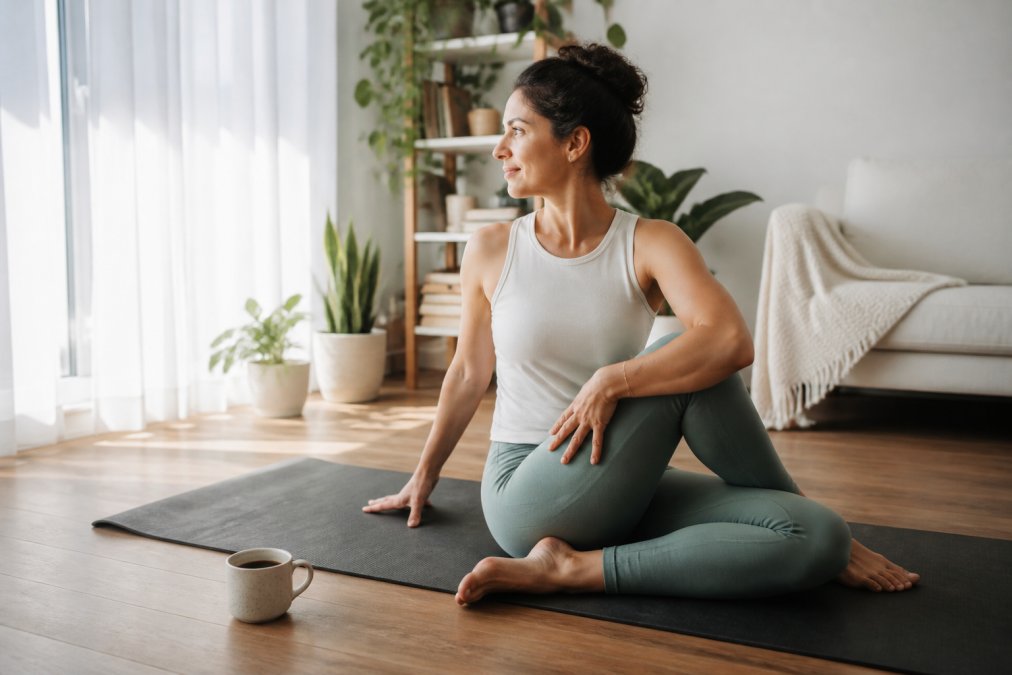
Minute-by-Minute Breakdown
- Minutes 1-2: Seated breathing. Sit tall, close your eyes, and take slow deep breaths.
- Minutes 3-4: Neck and shoulder rolls. Release tension built up overnight.
- Minutes 5-6: Cat-cow flow. Move your spine gently on all fours.
- Minutes 7-8: Standing forward fold and side bends. Wake up your back and hips.
- Minute 9: Gentle twist. Lie down and rotate your spine side to side.
- Minute 10: Rest. Lie still, breathe, and notice how your body feels.
That last minute matters most. It's where sensory awareness settles in and the practice becomes meditation.
Breathwork and Meditation to Anchor the Ritual
Breathwork is the thread that holds a morning ritual mindful movement practice together. Without it, you're just stretching. The reason is mechanical: your breath is the only autonomic function you can consciously control, so it acts as a manual override for the nervous system.
Why the Exhale Does the Work
Slow breathing at roughly six breaths per minute, about a four-second inhale and a six-second exhale, increases what researchers call heart rate variability. That variability reflects the balance between your sympathetic (alerting) and parasympathetic (calming) branches. A longer exhale relative to the inhale tips that balance toward the calming branch. This is why the pattern below emphasizes the out-breath, not the in-breath.
Three Breath Patterns, Matched to Your Morning
Pick one. You don't need all three.
- Box breathing (4-4-4-4). Inhale four, hold four, exhale four, hold four. Best when you wake up scattered and need to gather attention before movement. Four to six rounds.
- Extended exhale (4-6). Inhale four, exhale six. Best when you wake up tense or anxious. Five rounds.
- Coherent breathing (5.5-5.5). Inhale and exhale at roughly five and a half seconds each. Best as a default, it lands near the six-breaths-per-minute range linked to heart rate variability. Five minutes.
If you feel lightheaded, shorten the counts. Dizziness usually means you're pushing the pace faster than your body wants.
Making the Meditation Stick
After breathwork, sit still for two or three minutes. Let thoughts pass without chasing them. This is the present-moment awareness that meditation builds, and it's easier to reach when your breath is already slow.
- Anchor to a sensation, not a blank mind. Feel the air at your nostrils or your hands on your knees. Returning to that anchor is the practice, not a failure of it.
- Start with one minute. Consistency beats duration every time. A daily sixty seconds outperforms a weekly twenty minutes.
A Note on Apps and Timers
You don't need an app, but a simple interval timer helps if you lose count. Set it for five minutes and let it mark the rounds so your attention stays on the breath instead of the clock.
Minimalist Rubber Yoga Mat with →
The Yoga and Coffee Morning Ritual
Pairing movement with a warm cup is one of the oldest morning rhythms there is. The yoga and coffee morning ritual works because it links two calming experiences back to back.
Here's the sequence:
- Move through your ten-minute routine.
- Sit down while your body is still warm and loose.
- Pour a balanced, smooth cup and drink it slowly.
- Let the warmth and aroma center your senses before the day starts.
Adapting the Routine for Physical Limitations
Most morning movement guides assume a body that can get to the floor, fold forward, and twist without complaint. That's not most bodies. Mindful movement should meet your body where it is, and the same ten minutes still work with the right substitutions.
If You're Pregnant
- Skip deep twists and closed forward folds. Both compress the abdomen. Substitute open twists, rotate from the ribcage with the belly left long, and a wide-legged forward fold with hands on a chair or block.
- Avoid lying flat on your back after the first trimester. Substitute a side-lying rest or a seated forward fold for the closing minute.
- Keep the breathwork. The extended exhale pattern is often the most useful part of the routine during pregnancy.
If You're Recovering From Injury
- Low back: Replace cat-cow with a seated pelvic tilt, and skip standing forward folds entirely. A supine knee-to-chest on the floor is gentler than a fold.
- Shoulder or neck: Keep neck rolls small, a half-circle rather than a full rotation, and substitute shoulder blade squeezes for full shoulder rolls.
- Knee: Do everything seated in a chair. Cat-cow becomes a seated spinal wave; standing poses become seated leg extensions.
If You Have Limited Mobility or Use a Wheelchair
Every pose in the ten-minute routine has a seated equivalent:
- Seated breathing, unchanged.
- Neck and shoulder rolls, unchanged.
- Cat-cow, seated spinal flexion and extension, hands on thighs.
- Forward fold and side bends, seated side bends with one hand reaching toward the floor.
- Twist, seated spinal twist, hands on the chair back or armrests.
- Rest, seated, eyes closed, hands resting on the lap.
If You Have Limited Space
You don't need a mat-length footprint. A three-foot square works for every seated and standing variation above. If you can extend your arms without hitting a wall, you have enough room.
The One Rule That Covers All of It
Keep every movement within a pain-free range. Discomfort from a stretch is fine; sharp pain is a signal to back off. The Yoga Class T-Shirt carries a simple reminder on the front: don't force it, just breathe. That's the whole rule for adapting any pose.

Common Mistakes and Troubleshooting Consistency
Other common slips:
- Skipping breathwork to save time. It's the part that makes the rest work.
- Doing too much on day one, then quitting by day four.
- Chasing perfect form instead of comfortable motion.
- Practicing in a cluttered, noisy space.
For the days you're rushed, keep a Yogalatte Slim Water Bottle filled and ready. Its vacuum-sealed stainless steel frame keeps drinks at temperature for hours, so hydration never becomes the excuse.

Frequently Asked Questions
What is the best morning routine for mindfulness?
A morning ritual mindful movement practice works best when it combines three elements: gentle movement to wake the body, breathwork to settle the nervous system, and a few minutes of stillness or intention-setting. Start with five to ten minutes of yoga-inspired movement like cat-cow or a standing forward fold, follow with slow deep breathing, and finish with a quiet moment holding a warm drink. The order matters less than doing it at the same time each day, which helps your body anticipate the transition from sleep to wakefulness.
What are some examples of mindful movement activities?
Mindful movement covers any physical activity done with present moment awareness rather than performance goals. Common examples include gentle stretching, a body scan while lying down, yoga-inspired sequences like sun salutations done slowly, walking meditation, and guided meditation that includes simple arm or spine movements. Even five minutes of deliberate, slow motion counts. The key is paying attention to sensation rather than counting reps, which is what separates a 10 minute mindful movement routine from a standard workout.
How does mindful movement improve mental clarity?
Movement paired with breathwork supports self-regulation by engaging the parasympathetic branch of the autonomic nervous system, which can reduce the physical sensations of stress and help clear mental clutter. Many practitioners report feeling more focused and grounded after a short morning session, though individual results vary. Combining movement with a consistent wake time and morning light exposure supports circadian rhythm and cortisol regulation, both of which influence energy levels and cognitive focus through the day.
How can I build a consistent morning ritual?
Consistency comes from lowering the barrier to entry, not from willpower. Pick a fixed wake time, lay out your mat and mug the night before, and commit to a ten-minute version on busy days rather than skipping entirely. Habit stacking helps: attach the new practice to something you already do, like boiling water for coffee. Track your streak for the first three weeks, and if you miss a day, resume the next morning without adding extra time as penance. Small and repeatable beats long and sporadic.
Building a morning ritual that actually sticks is hard when your mornings feel rushed and scattered. Yogalatte makes the calm part easier with balanced, smooth coffee blends, a 12-ounce ceramic mug built for slow sips, and yoga-friendly pieces designed for quiet practice. Start your day with clarity and warmth. Shop now and give your morning the rhythm it deserves.